
When Does an Active Record Query Actually Run?
An ActiveRecord::Relation is deferred query intent, not database truth.
The first trap in Active Record is that the code often looks more decisive than it is.
invoices = current_account.invoices
  .where(status: "overdue")
  .order(due_at: :asc)
That reads like Rails went to the database and fetched overdue invoices.
It did not.
In the ordinary read path, this expression built an ActiveRecord::Relation. It gathered intent: which table, which conditions, which order, which model class should eventually receive the rows. But it did not necessarily send SQL to the database, receive rows, or instantiate Invoice objects.
That difference is easy to miss because Active Record relations are deliberately comfortable. You can chain them like queries, pass them through service objects, return them from scopes, hand them to views, and eventually treat them like collections.
That is the abstraction.
The database work may happen much later than the line where the query was described.
Consider a controller action that wants to show the first fifty overdue invoices:
class Admin::InvoicesController < ApplicationController
  def index
    invoices = current_account.invoices
      .where(status: "overdue")
      .order(due_at: :asc)

    if invoices.present?
      @invoices = invoices.limit(50)
    else
      flash.now[:notice] = "No overdue invoices."
    end
  end
end
This is ordinary Rails code. Nothing looks reckless. The relation is readable. The limit(50) is right there.
Then production traffic finds the account with 80,000 overdue invoices.
The request becomes slow, memory jumps, and the logs show something like this:
Invoice Load (1842.7ms)
  SELECT "invoices".*
  FROM "invoices"
  WHERE "invoices"."account_id" = 42
    AND "invoices"."status" = 'overdue'
  ORDER BY "invoices"."due_at" ASC

Invoice Load (12.8ms)
  SELECT "invoices".*
  FROM "invoices"
  WHERE "invoices"."account_id" = 42
    AND "invoices"."status" = 'overdue'
  ORDER BY "invoices"."due_at" ASC
  LIMIT 50
The expensive query is the innocent-looking empty check:
invoices.present?present? calls blank?, and for an Active Record relation, blank? needs the relation’s records. That means the relation is loaded. Not counted. Not checked with SELECT 1. Loaded.
The neighboring methods do not all cross the same line:
invoices.blank?   # loads records
invoices.present? # loads records
invoices.empty?   # if loaded, asks an existence question
The problem is not that every collection-looking method is dangerous in the same way. The problem is that each can force the relation to answer a different kind of question.
The guard that was supposed to ask “Is there anything here?” accidentally asked Rails to materialize every matching row before the limited relation was even assigned.
This is the first persistence-boundary mistake.
The Ruby object you are holding is not database truth. It may only be deferred query intent.
Until something forces execution, the relation is just a plan.
A Relation Is Not an Array
We can read Invoice.where(status: “overdue”) as “overdue invoices”, but a more precise reading is “a relation that can later fetch overdue invoices”.
That relation knows enough to become SQL, but it is not yet the result of that SQL.
You can see the difference in a console if you avoid letting the console inspect the relation for you:
relation = Invoice.where(status: "overdue").order(:due_at)

relation.class
# => ActiveRecord::Relation

relation.loaded?
# => false

relation.to_sql
# => SELECT "invoices".* FROM "invoices"
#    WHERE "invoices"."status" = 'overdue'
#    ORDER BY "invoices"."due_at" ASC

relation.loaded?
# => false
to_sql is a great tool for inspecting query shape. It shows the statement Rails has built, but does not run it.
The relation becomes loaded when Rails actually needs records:
records = relation.to_a

relation.loaded?
# => true

records.first
# => #<Invoice id: 1, status: "overdue", ...>
For a record-loading call like to_a, this is the basic lifecycle:
relation construction
query clauses accumulate
an execution method is called
SQL is generated
the database adapter executes it
rows come back
model objects are instantiated
the relation is marked loaded
Most confusion comes from mentally skipping the first three steps and imagining the relation already contains rows.
The Execution Edges
An Active Record relation crosses into database work when you ask a question that requires database information or records.
The edges are not all the same.
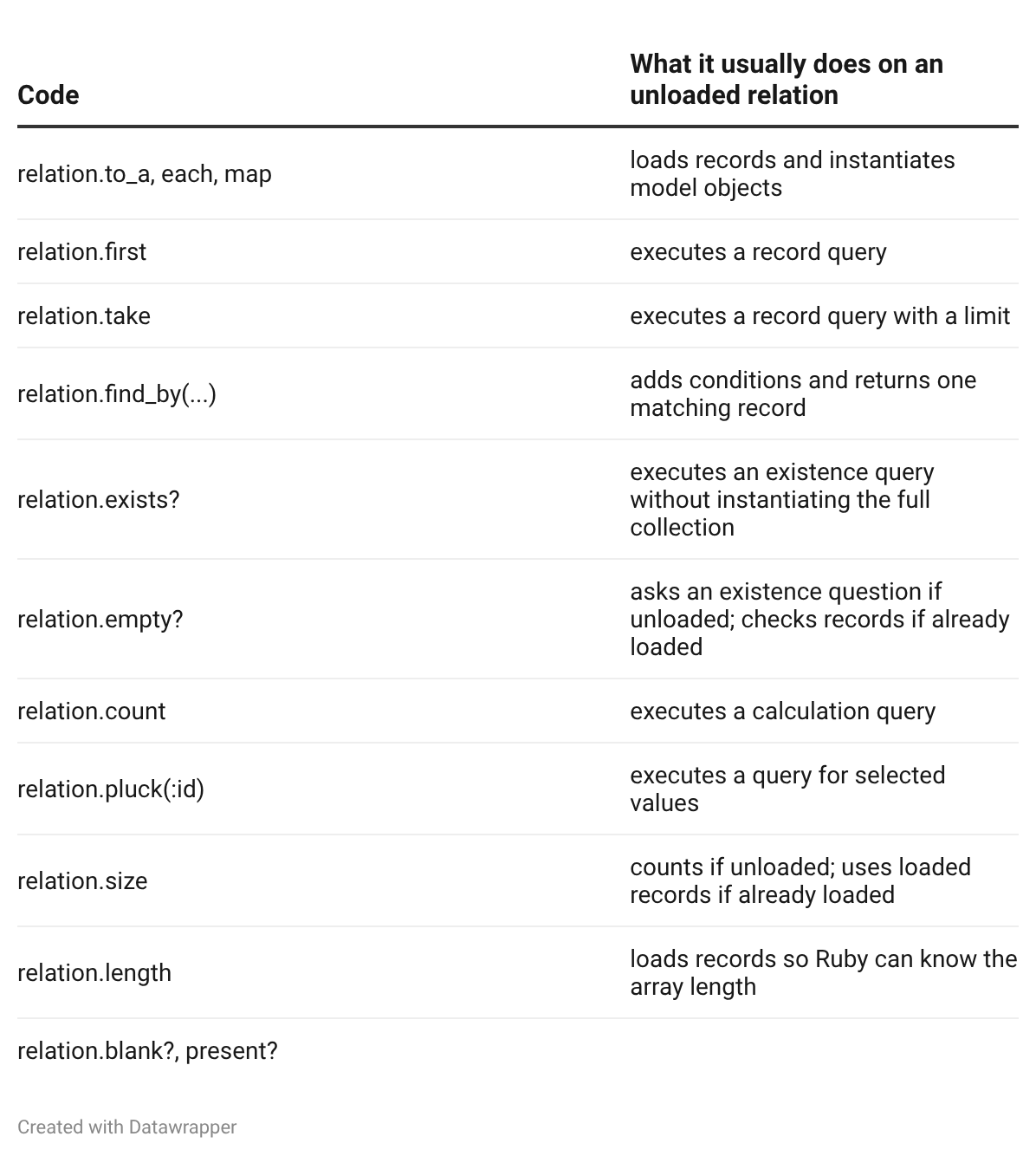
The table is not a replacement for reading logs because details can vary depending on eager loading, limits, grouping, selected columns, and adapter behavior. But it gives you the debugging reflex: do not ask “did I write a query?” Ask “which method forced this relation to answer?”
first, take and find_by are worth separating because they look similar in how they fetch one record, but they do not carry the same ordering meaning. first uses an existing order, or falls back to primary-key order if none is defined. take does not imply application-level ordering. find_by adds conditions, then returns one matching row.
count, size, and length show the same problem from the other direction. They look interchangeable in Ruby, but they are not interchangeable in Active Record.
relation = Invoice.where(status: "overdue")

relation.count
# SELECT COUNT(*) FROM "invoices" WHERE "invoices"."status" = 'overdue'

relation.loaded?
# => false

relation.size
# SELECT COUNT(*) FROM "invoices" WHERE "invoices"."status" = 'overdue'
# because the relation is still unloaded

relation.length
# SELECT "invoices".* FROM "invoices" WHERE "invoices"."status" = 'overdue'
# then instantiate the records

relation.loaded?
# => true

relation.size
# now uses the loaded records
The names are ordinary Ruby names, but the behavior is persistence-boundary behavior.
count asks the database for a number. length needs a loaded Ruby collection. size adapts to the relation’s loaded state.
Some Queries Return Answers Without Loading the Relation
Not every execution turns the relation into loaded model objects.
This is important because otherwise the debugging model becomes too blunt. “Lazy versus loaded” is not the only difference. Sometimes Rails executes SQL and still does not load the relation’s record array.
relation = Invoice.where(status: "overdue")

relation.exists?
# SELECT 1 AS one FROM "invoices"
# WHERE "invoices"."status" = 'overdue'
# LIMIT 1

relation.loaded?
# => false
The database was queried, but the relation is still not loaded.
The same idea applies to calculations and value queries:
relation.count
relation.sum(:total_cents)
relation.pluck(:id)
These execute SQL, but they do not populate the relation’s loaded records. A later iteration can still issue another query for records.
This is a common log pattern:
invoices = Invoice.where(status: "overdue")

Rails.logger.info("Overdue invoice count: #{invoices.count}")

invoices.each do |invoice|
  InvoiceMailer.reminder(invoice).deliver_later
end
The count did not warm the relation:
Invoice Count
  SELECT COUNT(*) FROM "invoices"
  WHERE "invoices"."status" = 'overdue'

Invoice Load
  SELECT "invoices".*
  FROM "invoices"
  WHERE "invoices"."status" = 'overdue'
That may be perfectly acceptable. Sometimes you need both a count and the records. But if you expected one query, the logs look like Rails is doing mysterious extra work.
If you look closely, you’ll notice that you asked two different questions.
One question was “how many rows match this relation?”
The other was “give me model objects for these rows.”
Fix the Empty-State Bug
Return to the original controller:
invoices = current_account.invoices
  .where(status: "overdue")
  .order(due_at: :asc)

if invoices.present?
  @invoices = invoices.limit(50)
else
  flash.now[:notice] = "No overdue invoices."
end
There are a few better versions, depending on what the action really needs.
If the page is going to render the first fifty records anyway, load the page-shaped relation and ask the loaded page whether it is empty:
@invoices = current_account.invoices
  .where(status: "overdue")
  .order(due_at: :asc)
  .limit(50)
  .load

if @invoices.empty?
  flash.now[:notice] = "No overdue invoices."
end
If the branch only needs to know whether anything exists, and you are not about to render the records, ask an existence question:
invoices = current_account.invoices.where(status: "overdue")

if invoices.exists?
  # show a link, schedule work, or continue
else
  flash.now[:notice] = "No overdue invoices."
end
If you need both existence and records, decide whether two queries are acceptable. Sometimes they are. Sometimes it is cleaner to load the limited records once and branch on the loaded result.
The important move is not merely deciding “never use present? on a relation”, though that is a good instinct in many code paths. The important move is naming the state you are holding:
Is this still a deferred query intent?
Did I ask the database for a scalar answer?
Did I load model objects?
Am I reusing the same loaded relation, or have I created a new one?
Those questions turn Active Record from magic into a trace.
A shorter companion note isolates this specific trap: present? and the hidden boundary.
Why Rails Has Relations at All
ActiveRecord::Relation is not only a laziness trick.
It is how Rails lets application code keep describing database work until the final shape of the query is known.
Real Rails queries are rarely born complete. A controller may begin with the current account’s records. A policy may narrow them. A search object may add optional filters. A scope may add business vocabulary. Pagination may add a limit and offset. The view may need preloaded associations. Each layer contributes part of the eventual query.
scope = current_account.invoices
scope = scope.where(status: params[:status]) if params[:status].present?
scope = scope.where("due_at <= ?", params[:due_before]) if params[:due_before].present?
scope = policy_scope(scope)
scope = scope.includes(:customer)
scope = scope.order(due_at: :asc)
scope = scope.limit(50)
If Rails query entry points immediately materialized arrays, every later step would be forced to work with already-loaded Ruby objects. Filtering might happen in memory. Pagination might happen after too many rows had crossed the database boundary. Authorization scopes would have less room to become SQL. Preloading decisions would arrive after the first query had already run.
The relation is the object that keeps those choices open.
It lets Rails say:
not yet
not yet
not yet
now run this final query
That “not yet” is what lets scopes compose:
Invoice.overdue.billable.order(:due_at).limit(50)It is what lets associations behave like query entry points:
account.invoices.overdue.limit(50)And it is what lets the same base intent produce different final queries:
overdue = current_account.invoices.where(status: "overdue")

overdue.count
overdue.limit(50)
overdue.pluck(:id)
Those are not three ways of reading the same loaded array. They are three different questions built from the same deferred intent.
A relation lets Rails delay execution because the application has not finished describing the work yet.
Query Method Accumulate Intent
Methods like where, order, limit, select, joins, and named scopes usually keep you in relation-building territory.
base = Invoice.where(status: "overdue")
page = base.order(:due_at).limit(50)
csv  = base.order(:id).select(:id, :number, :total_cents)
These are three different relation objects. They share parts of the same intent, but each one has its own query shape.
The important detail is that chaining does not mutate one loaded collection in place. Active Record relations are composable query objects. A later method usually returns another relation with additional or changed query values.
That is why this code does not load once and then slice in memory:
invoices = Invoice.where(status: "overdue")
page = invoices.limit(50)
The limit belongs to the query plan for page. It is not applied to a Ruby array unless invoices has already been loaded and you explicitly start working with arrays.
Passing a Relation Means Passing Future Work
That composability is useful, but it has an edge: a relation can travel through your application before anyone notices it still represents future database work.
For example, a search object might return a relation instead of records:
class InvoiceSearch
  def initialize(account:, params:)
    @account = account
    @params = params
  end

  def relation
    scope = @account.invoices
    scope = scope.where(status: @params[:status]) if @params[:status].present?
    scope = scope.where("due_at <= ?", @params[:due_before]) if @params[:due_before].present?
    scope.order(due_at: :asc)
  end
end
This object has not hidden database I/O itself. It has hidden query construction, which is a much safer thing to hide.
That is often a good design. It lets the controller decide the final shape:
relation = InvoiceSearch.new(account: current_account, params: params).relation

@invoices = relation.limit(50)
But the risk remains. If a policy, serializer, logging statement, helper, or view calls an execution method before the controller applies pagination or preloading, the query may run with the wrong shape.
A relation is a transportable promise of future database work. Passing a relation around is not passing data around. It is passing a capability to perform database work later.
This becomes especially important once associations enter the picture, because associations often make deferred query intent look like ordinary object navigation:
account.invoicesThat expression feels like “the account’s invoices.” In many cases, it is really “a query interface scoped to this account’s invoices.”
The Console Can Add Noise
The Rails console is helpful, but it can teach this topic badly if you trust what appears after pressing enter.
When the console prints a relation, it calls inspection methods so you can see something useful. Rails’ relation inspection may execute a limited query for display. That does not mean where itself eagerly fetched records. It means the console asked the relation to show itself.
Invoice.where(status: "overdue")If the console immediately prints sample invoices, the display step crossed an execution edge.
When you are checking laziness, assign the relation and ask precise questions:
relation = Invoice.where(status: "overdue")
relation.loaded?
relation.to_sql
Then trigger the edge deliberately:
relation.load
relation.loaded?
That keeps the console from becoming part of the behavior you are trying to understand.
Where This Lives in Rails
The main object here is ActiveRecord::Relation.
A relation carries the model, table, predicate builder, and query values that Rails needs to build SQL. In Rails’ initialization path, a new relation starts out unloaded. The relation can accumulate clauses for a while before records exist.
ActiveRecord::QueryMethods provides much of the chainable query API: where, order, limit, select, joins, includes, and the rest of the vocabulary Rails developers use every day. These methods generally return relations, not arrays.
Relation#to_sql compiles the relation into an SQL string. It is a way to inspect the generated statement.
Relation#load is one of the places where the boundary becomes explicit. If the relation is not loaded, Rails executes the query, stores the resulting records on that relation, and returns the relation itself.
Under that call sits the machinery that turns relation intent into database work: Arel represents the query structure, the adapter compiles and executes SQL appropriate for the database, rows return from the database, and Active Record instantiates model objects from those rows.
You do not need to think about Arel every time you write a scope. But it is useful to know that where(status: “overdue”) is not a string being glued onto a future SQL statement. Rails is building a query representation that the adapter can later compile.
These three tell you what Rails plans to run, whether this relation has records, and when you intentionally cross the boundary:
relation.to_sql
relation.loaded?
relation.load
The Debugging Reflex
When a request performs unexpected database work, do not start by asking whether Active Record is slow.
Start with the execution edge.
A practical trace looks like this:
relation = current_account.invoices.where(status: "overdue")

Rails.logger.info(relation.to_sql)
Rails.logger.info("loaded before? #{relation.loaded?}")

page = relation.limit(50).load

Rails.logger.info("loaded after? #{page.loaded?}")
Then compare that trace with the SQL logs.
If a query appears earlier than expected, search for collection-like calls:
each
map
to_a
as_json
blank?
present?
empty?
length
first
take
find_by
count
exists?
pluck
Some of those load records. Some execute scalar queries. Some instantiate model objects. Some do not. The point is to stop treating them as equivalent Ruby collection methods once the receiver is an ActiveRecord::Relation.
The useful debugging question is:
Am I still holding a deferred query intent, or did something already force database work?
Once the query runs, Rails crosses into the next state. It has rows from the database and turns them into model instances. Those objects feel like rows, but they are not rows either. They are Ruby snapshots of database-backed state, loaded at a particular moment, capable of drifting away from the database as soon as time and other writers move on.
That is the next persistence-boundary mistake: once records are loaded, the confusion moves from query intent to object state.